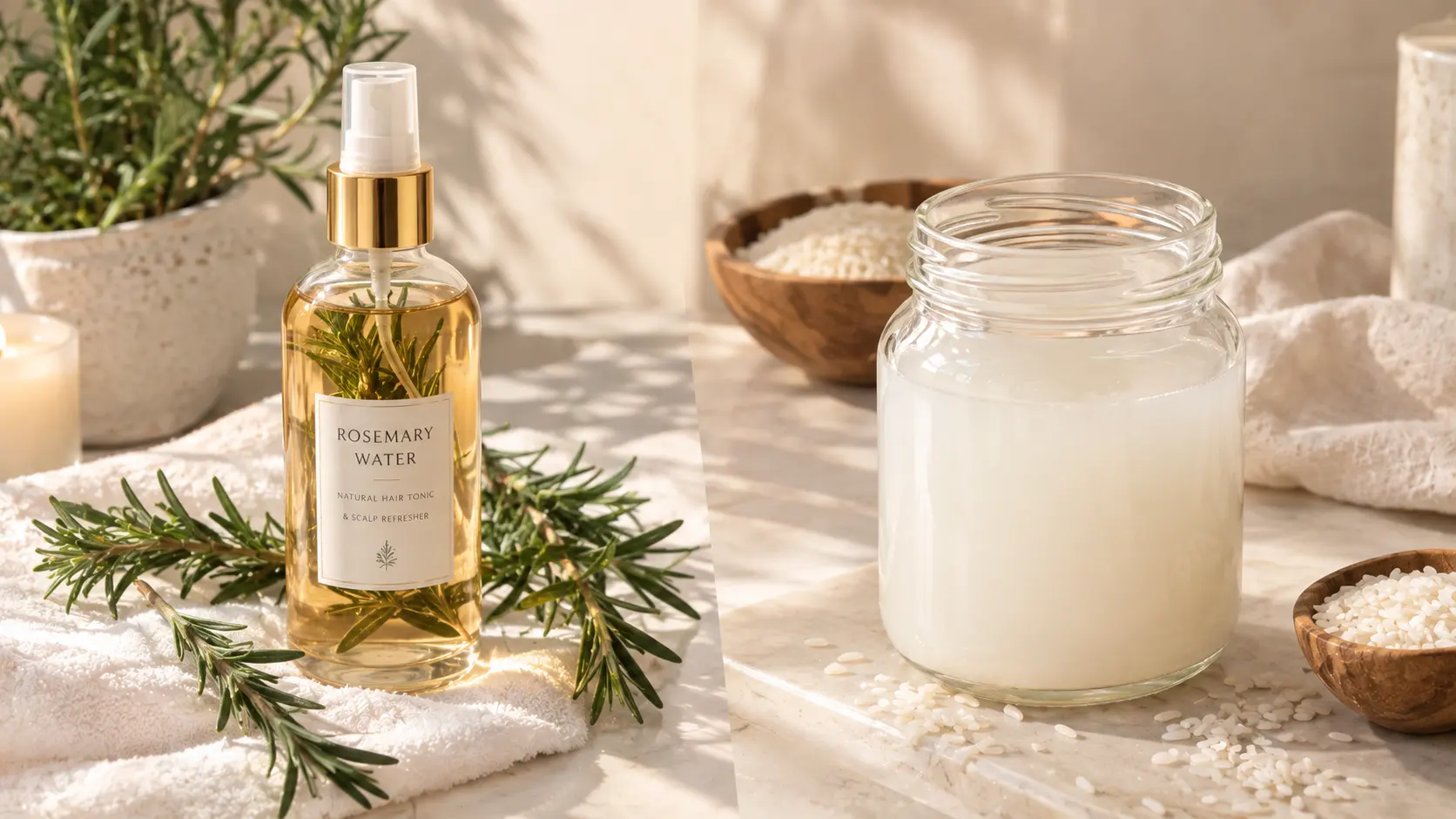
Rosemary Water vs. Rice Water for Hair Growth: The Ultimate Showdown
If you’ve spent any time on Pinterest or TikTok lately, you’ve undoubtedly seen the viral hair care debates. On one side of your feed, creators are showing off crazy baby hair growth using a simple herbal spray. On the other side, people are flaunting knee-length, glass-like hair claiming it’s all thanks to a cloudy, fermented wash.
The rosemary water vs rice water debate has completely taken over the natural hair care community. But if you are feeling confused about which one you should actually be using, you are not alone.
Here is the biggest mistake most people make: they treat these two viral liquids like they are competing for the exact same job.
Spoiler alert: They are not.
While the internet often pits them against each other, the scientific reality is that they serve completely different purposes for your hair. They don’t fight each other; they target entirely different problems.
To put it simply:
- Rosemary water is a powerful scalp care treatment designed to stimulate blood circulation and target hair thinning right at the root. (Want the recipe? Check out our guide on How to Make Rosemary Water for Hair Growth).
- Rice water, on the other hand, is a deep hair conditioning treatment meant to smooth your hair shaft, reduce friction, and stop breakage so you can actually retain your length. (See the exact method in our Ultimate DIY Rice Water Recipe).
Choosing the right one isn’t about which ingredient is “better”—it’s about understanding what your specific hair needs right now. Factoring in things like your hair porosity, scalp health, and current damage level is the real secret to getting those viral results.
Whether you are trying to recover from severe hair fall, looking to add a deep shine, or just want to upgrade your daily routine (much like our popular 7-Day Aloe Vera Hair Routine), we are going to break down the exact science, benefits, and differences between these two powerhouse ingredients.
By the end of this showdown, you’ll know exactly whether you need the root-boosting power of rosemary, the length-retaining magic of rice water, or perhaps a stronger solution like Rosemary Hair Oil. Let’s dive into the facts and separate the internet trends from real science!
Table of Contents
1. Understanding Rosemary Water (The Scalp Booster)
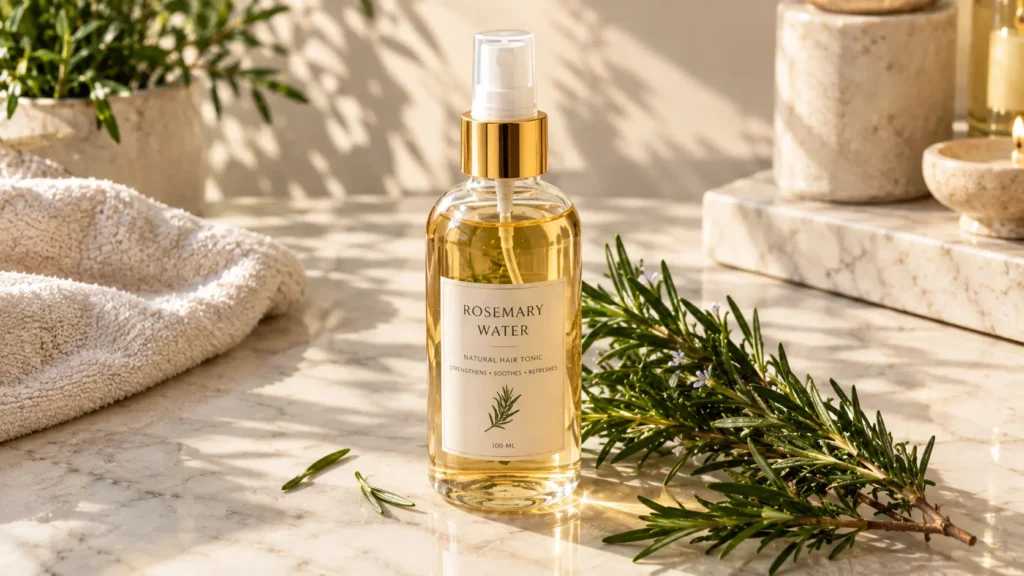
When comparing rosemary water vs rice water, we first need to clear up a massive internet misconception: rosemary water is NOT the same thing as rosemary essential oil.
While rosemary essential oil is a highly concentrated, volatile extract that must be carefully diluted with carrier oils (which you can learn all about in our Exact Dilution Ratio for Rosemary Hair Oil guide), rosemary water is a gentle, aqueous preparation made directly by steeping the actual plant in water. Because it is completely water-based, it is incredibly lightweight, completely non-greasy, and designed specifically to act as a targeted scalp booster.
Key Benefits of Rosemary Water
If you are dealing with excessive shedding, thinning edges, or stubborn bald spots, rosemary water is going to be your best friend. Here is what it actually does when applied correctly:
- Acts as a Scalp Power Booster: Rosemary naturally contains powerful antioxidants that instantly improve blood circulation when applied to the scalp. Better blood flow means your roots are finally getting the oxygen and nutrients they desperately need to grow.
- Strengthens Follicles & Fights Hair Fall: By waking up dormant hair follicles, rosemary water deeply strengthens your hair right at the root. This makes it highly effective for targeting bald spots and strictly controlling hair fall.
- Reduces Wash-Day Shedding: Users frequently report a refreshing cooling sensation upon application. More importantly, it anchors the hair better, significantly reducing the terrifying amount of hair you lose during wash days.
- Realistic Timeline for Results: Natural hair care is a science, not magic. You will typically need 2 to 3 weeks of consistent, daily use before you start noticing visible changes, such as heavily reduced hair fall and the appearance of new baby hairs.
How to Make & Apply It
Making this viral treatment at home is incredibly simple, cost-effective, and guarantees you are getting a 100% pure product without any hidden preservatives.
The Quick DIY Recipe:
- Bring one glass of water to a rolling boil in a pan.
- Add 2 to 3 spoons of dried rosemary leaves (or fresh sprigs if you have a rosemary plant at home).
- Let it simmer briefly, then turn off the heat and let it steep for 20 to 30 minutes. This resting period is crucial for the water to fully infuse and pull out all the nutrients.
- Once it cools down to room temperature, strain the botanical liquid directly into a spray bottle. (Need more tips on storing and using this daily? Check out our complete guide on How to Make Rosemary Water for Hair Growth).
The Expert Application Secret: Here is where most people fail and say the product didn’t work: do not just spray this on your hair lengths.
- Part your hair and spray primarily onto your scalp.
- Massage your scalp for 10 to 20 minutes. This step is non-negotiable! The massage physically stimulates the blood circulation and ensures the water is deeply absorbed into the follicles.
- Because this is a completely water-based, zero-oil formula, it will not leave your hair looking flat or greasy. You can easily spray it on at night, let it air dry, and you do not need to wash it out the next morning!
2. Understanding Rice Water (The Length Retainer)
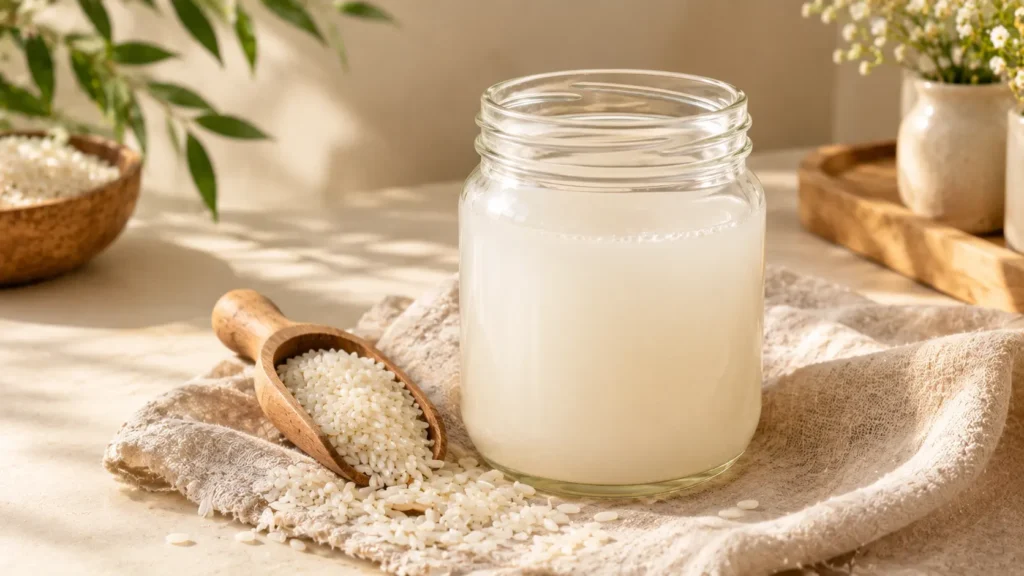
In the ongoing rosemary water vs rice water discussion, if rosemary is the root stimulator, think of rice water as your ultimate length retainer. The milky, cloudy liquid left over after soaking or boiling rice has been a staple in Asian beauty traditions for centuries, and for a very good reason.
Rice water is packed with heavy-hitting nutrients like starches, vitamins, minerals, and amino acids. Together, these ingredients act as a powerful natural smoother for the hair shaft. It does not necessarily stimulate the follicle like rosemary does; instead, it works entirely on the outer layers of the hair you already have.
Key Benefits of Rice Water
If you are struggling with split ends, constant tangling, or hair that just won’t seem to grow past a certain point, rice water is exactly what you need. Here is how it transforms your hair:
- Deep Conditioning & Manageability: Rice water acts primarily as a high-performance hair conditioning treatment. The starches coat the hair strands, heavily reducing friction. This makes detangling incredibly easy and vastly improves overall manageability.
- The Secret to “Faster” Hair Growth: Here is the truth about rice water for hair growth: it doesn’t magically make your follicles produce hair faster. Instead, it strengthens the hair shaft, significantly reducing hair breakage. When your hair stops snapping off at the ends, you finally get to retain your length, making your hair appear to grow much faster!
- Eliminates Frizz & Adds Glass-Like Shine: The amino acids deeply nourish the hair, effectively smoothing out rough, frizzy cuticles and leaving behind a brilliant, deep shine.
- Balances Scalp Oiliness: If you struggle with greasy hair that gets oily just two days after washing, fermented rice water helps balance the scalp’s pH levels, naturally reducing excess oil production.
How to Make & Apply It
Making a fresh batch of rice water is practically free and takes just a few minutes of prep time.
The Quick DIY Recipe:
- Take 2 to 3 spoons of rice and rinse it quickly to remove dirt.
- Place the clean rice in a bowl and add one cup of water.
- Let it soak for 2 to 3 hours, or ideally, leave it overnight to ferment. Fermenting is the golden step that draws out all the essential vitamins and antioxidants!
- Strain the fermented water into a spray bottle and it is ready to use.(For our exact step-by-step fermentation secrets, check out our guide on The Ultimate DIY Rice Water Recipe for Extreme Hair Growth).
The Expert Application Secret: This is where the application differs completely from rosemary!
- Do not soak your scalp in it. Because rice water is rich in proteins and starches, using it excessively on your roots can cause buildup, especially depending on your hair porosity.
- Instead, spray this mainly on the mid-lengths and ends of your hair. This is where your hair is the oldest, most damaged, and needs the most protein.
- You can use it as a pre-wash treatment, or spray it lightly after washing to let the amino acids lock in that flawless shine.
3. Head-to-Head Comparison (Quick Reference Table)
If you are just skimming and want the quickest answer to the rosemary water vs rice water debate, we’ve broken down exactly what each treatment is actually built to do.
| Feature | Rosemary Water | Fermented Rice Water |
| Primary Target | The Scalp & Roots | Mid-Lengths & Ends |
| Main Function | Scalp health, blood circulation, and follicle stimulation | Deep conditioning, frizz control, and length retention |
| Best For | Hair thinning, severe hair fall, and sparse edges | Breakage, extreme dullness, tangling, and split ends |
| Application | Sprayed and vigorously massaged directly into the scalp | Sprayed primarily onto the hair lengths (avoid heavy root use) |
| Consistency | Extremely lightweight, zero-oil, feels like pure water | Slightly heavier, milky, and highly protein-rich |
4. Which One is Best for Your Specific Hair Type?
In the world of natural hair care, one size absolutely does not fit all. The biggest mistake people make is forcing a trending product onto hair that simply doesn’t want it. To get the best results in the rosemary water vs rice water showdown, you need to match the treatment to your specific hair porosity and texture.
Fine or Low Porosity Hair
If your hair is very fine or gets weighed down easily, rosemary water is your ultimate winner. Because it is a completely aqueous, lightweight extract, it will never leave your hair looking flat, greasy, or stringy.
On the flip side, using heavily concentrated rice water on low porosity hair can quickly lead to protein overload. The starches may sit on the outside of your hair shaft, making it feel stiff, brittle, or “coated.” If you have fine hair but still want to boost growth, stick to the lightweight scalp stimulation of rosemary!
Thick, Coarse, or High Porosity Hair
High porosity hair naturally struggles to hold onto moisture, which leads to severe dryness and constant snapping. If your hair is thick, curly, or highly porous, rice water is going to change your life.
Thicker hair textures can easily tolerate and absorb the rich, protein-heavy conditioning of rice water for hair growth. It acts as a structural filler, smoothing down the rough cuticles so your hair feels incredibly soft and detangles with zero effort. (Note: Thick hair can also handle much heavier, moisture-locking treatments—if this sounds like you, consider upgrading to our Rosemary Hair Oil Routine).
Oily, Sensitive Scalps
If you have a scalp that gets excessively oily just a day or two after washing, you need to focus on pH balance. The fermentation process in rice water naturally lowers its pH, which helps balance the scalp’s pH levels and reduces excess oiliness over time.
However, if your oily scalp is also paired with active hair fall, you might benefit from alternating treatments. You can easily soothe an irritated scalp using our 7-Day Aloe Vera Hair Routine to lock in hydration without the heavy oil production.
5. Can You Use Both Together? (The Hybrid Approach)
So, after breaking down the rosemary water vs rice water debate, what if you simply can’t decide? The good news is: you don’t actually have to choose just one.
The beauty industry has already figured out that these two ingredients are a match made in heaven. In fact, many viral commercial products right now (like the highly popular Bare Anatomy Rosemary & Rice Water Spray) are bottling both ingredients into a single formula. They do this because combining the powerful scalp-stimulating rosemary water benefits with the smoothing power of rice water for hair growth creates a true powerhouse treatment for natural hair care.
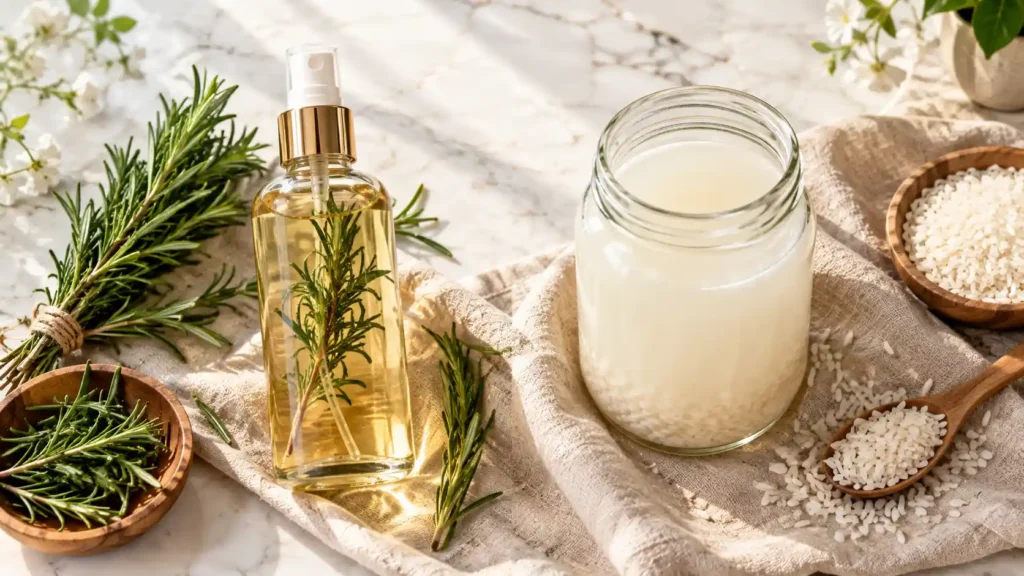
But you absolutely do not need to buy an expensive pre-made spray to get these results. You can easily create a customized DIY Hybrid Routine at home using two highly effective methods:
Method 1: Target-Specific Application (The Best Option)
Since we know these ingredients do entirely different jobs, apply them exactly where they are needed at the same time:
- The Roots: Spray your freshly made rosemary water directly onto your scalp and massage it in thoroughly to stimulate blood flow. (Need the exact measurements? Use our Zero-Oil Rosemary Water Guide).
- The Lengths: At the exact same time, spray your fermented rice water exclusively on your mid-lengths and split ends. (Make sure you are fermenting it correctly by following our Ultimate DIY Rice Water Recipe).
- This method guarantees you get the scalp benefits of rosemary without risking a protein overload from the rice water sitting on your roots!
Method 2: The Alternate-Day Cycle
If you have easily overwhelmed hair or tricky hair porosity, you can practice “hair cycling.”
- Monday: Treat your scalp with rosemary water.
- Tuesday: Smooth your lengths with rice water.
- Wednesday: Give your hair a break and focus on pure hydration. (This is the perfect day to incorporate our soothing 7-Day Aloe Vera Hair Routine).
By alternating days or even alternating weeks, you give your hair a balanced diet of both protein and circulation-boosting antioxidants. And remember, if you have extremely thick or dry hair that needs a stronger sealant than just water-based sprays, you can always finish off your routine by applying a few drops from our Exact Dilution Ratio Rosemary Hair Oil to your ends!
6. The Final Verdict: Separating Trend from Science
So, in the ultimate battle of rosemary water vs rice water, who actually wins?
The hard truth is: neither of these is a guaranteed magic hair growth solution. And that is the exact answer you need to remember. Healthy hair is never about finding a single miracle ingredient; it is about understanding what your hair actually needs and giving it that consistently.
- If your hair is breaking, tangling, or snapping off at the ends: Use rice water to deeply condition, improve manageability, and retain your length. (Check out our complete tutorial on The Ultimate DIY Rice Water Recipe for Extreme Hair Growth).
- If you need a scalp refresher or are dealing with active hair fall: Use rosemary water to stimulate blood flow and strengthen your roots directly. (Learn exactly how to brew it in our Rosemary Water Zero-Oil Daily Spray Guide).
Stop asking which viral product is “better” and start giving your hair a targeted routine. Whether you are balancing your scalp with a 7-Day Aloe Vera Routine for pure hydration, or sealing your damaged ends with our Exact Dilution Ratio Rosemary Hair Oil, the real secret to natural hair care is simply consistency!
Frequently Asked Questions (FAQ)
Do I need to wash my hair after applying rosemary water?
No! Because pure rosemary water is a completely water-based and non-sticky preparation, it will not leave your hair feeling oily, flat, or greasy. You can simply spray it onto your scalp, massage it in, let it air dry, and leave it in until your next normal wash day.
How long does it take to see results?
When choosing between rosemary water vs rice water, timeline matters. While rice water can show its smoothing and detangling effects almost immediately after the first or second use, rosemary water typically requires 2 to 3 weeks of consistent use to show visible scalp improvements and a true reduction in wash-day hair fall.
Can I use these treatments every day?
When it comes to natural hair care, more isn’t always better. While you can safely use rosemary water daily as a lightweight scalp refresher, using protein-heavy rice water every single day can cause issues like excessive protein or coating buildup, leading to stiffness and breakage. Always pay close attention to how your hair responds and adjust your frequency!
2 thoughts on “Rosemary Water vs. Rice Water for Hair Growth: Which Actually Works? (2026)”